|
|
The
HOUSE.
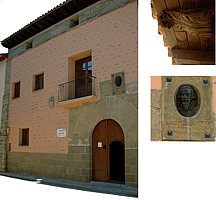
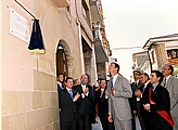
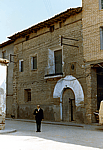
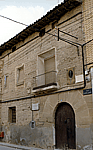
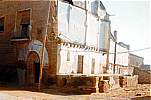
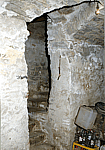
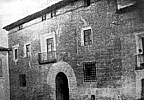
On July 10th, 2002, his Royal Highness,
Prince Felipe, inaugurated the house where Michael Servetus
was born in 1511. After a lengthy restoration (the house was
almost in ruins before), the inauguration of the house
fulfilled a long standing ambition of the Members of the
Michael Servetus Institute and the citizens of Villanueva de
Sijena, birthplace of Servetus.
The House of Michael
Servetus is now a research center which has become a reference
point for all those wanting to study Servetus’ life and works.
It is also a living monument to the memory of Servetus from
which the Institute spreads the values which inspired the life
of Servetus, and preserves them for future
generations. |
| |
| |
 |
The GROUND
FLOOR.
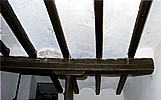
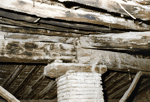
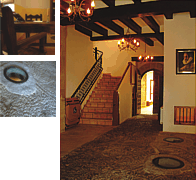
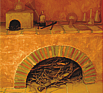
Upon entering the house, visitors can
contemplate the hall which was typical of the houses that were
owned by the so-called “infanzones” (lower Aragonian
nobility). In this room, the floor (made of small
cobblestones), the wine and oil cisterns, and the natural
fridge tank have been carefully restored.The
old stall has been converted into the conference room of the
house. In this room the place to crush grapes to make wine and
the cistern have been preserved.
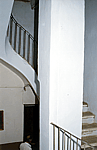
From the ground floor, a
set of stairs leads us to the former wine cellar, now
converted into a projection room in which visitors can watch a
20-minute video which describes vividly and with great
plasticity Servetus’ life and
time. | |
| |
FIRST
FLOOR.
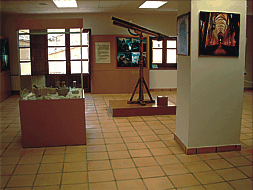
This floor contains
several panels with photographs and explanations of Servetus’
life and works. They are organized in such a way as to provide
visitors with a detailed introduction to Servetus’ life and
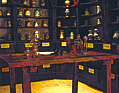
times. On this floor, visitors can also contemplate a
reproduction of a XVI Century chemical laboratory and a
pharmacy. |
|
|
|
 | |
| |
|
|
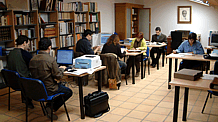
The LIBRARY
On the first floor, we find one of the most
important rooms in of the House. The library of the Michael
Servetus Institute contains one of the most comprehensive
collections of documents, books and photographs related to
Michael Servetus and the Royal Monastery of Sijena. The
Library is open to all researchers submitting sufficient
credentials and showing an interest in studying Servetus’
legacy or the history of the Monastery of Sijena. Computer
facilities are available, including a printer and a
scanner. | |
| |
|
The BARN
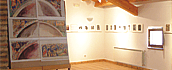
The former barn is now a
room used for exhibitions. When no exhibitions of paintings
are being held, visitors can contemplate an exhibition of
photographs related to the Monastery of Sijena. |
| |
| |
|
Visits:
Weekends: Saturdays, from 11:30 am to 2:30 pm and from 5 to 7 pm. Sundays: from 11:30 am to 2:30 pm. Public holidays: from 11:30 am to 2:30 pm
Closed Christmas, New Year Day and October 12th - National Holiday.
Groups: contact with the Council of
Villanueva to schedule your visit.
City Council
Tel.: + 34 974 57 81 37
Price:€ 2 /per
person. Senior citizens (retired): € 1.50/per person. Children from
12 to 13: € 1.50/per peson.
Groups (at least 10 people): €
1.50/per person. Schools: € 1/per person-student. |
| |
| Written and translated by
Sergio Baches Opi |
|
|
|
|
|
|
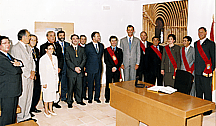
July 10, 2002 was a
remarkable day for the members of the Michael Servetus
Institute and the citizens of Villanueva de
Sijena. His Royal Highest
Prince Felipe de Borbón, Prince of Asturias and Gerona,
came to Villanueva accepting the invitation of the Civil
Council of the town to inaugurate de house of Michael
Servetus after its restoration.His Royal Highnest gave a
warm and solid speech in the main square of Villanueva
and the authorities of the region attending the event.
Prince Felipe de Borbón referred to Michael Servetus as
a Spanish humanist who left Spain to join the religious
debate which was taken place in central Europe, and who
influenced with his rational attitude the development of
science and
philosophy. | |
|
|
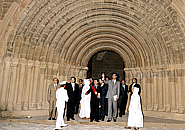
After this, His
Royal Highness paid homage to Michael Servetus by lying
flowers in his statue. The Major of Villanueva, Mr.
Ildefolso Salillas, and the President of the Region of
Aragón, Mr. Marcelino Iglesias, gave two welcoming
speeches. After the applauses of the public gathered in
the squared of Villanueva, his Royal Highnest,
accompanied by the local and regional authorities and
some members of the Michael Servetus Institute headed
out towards the Birth House of Michael Servetus.
|
|
| |
| |
|
|
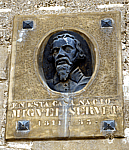
Once there, he
discovered in its façade a marble table commemorating
his visit and visited the house showing great curiosity
by the life and works of Servetus and expressing his
satisfaction for the restoriation of the house.Once the
visit was finished, his Royal Highnest signed in the
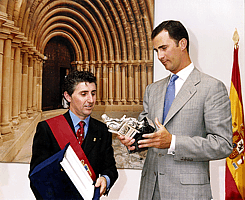
Book of Honor of the City Council of Villanueva. The
Michael Servetus Institute gave to Prince Felipe silver
statue of Michael Servetus which reproduces the statue
placed in the square of Villanueva. After all these
official events, the Civil Council of Villanueva offered
a drink to all those attending the visit. Setting aside
the protocol rules, His Royal Highnest joined in the
celebration, before heading towards the Royal Monastery
of Sijena where he was received by the religious
community currently inhabiting the
convent. |
| |
The Michael Servetus
Institute wants to thank His Royal Highnest for visiting
us in this important day for the Michael Servetus
Institute. His presence shows the special sensibility of
the Crown towards those areas of Spain which normally do
not draw the attention of the public
administrations. |
|
Written by Sergio
Baches Opi and César Calavera Opi - Translated by Sergio
Baches Opi
|
| |
|
|