|
|
|
|
|
|
| |
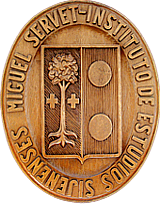
The Michael Servetus Institute
is a public non-profit educational and research institution located
in Villanueva de Sijena, a town of 500 inhabitants belonging to Los
Monegros (black mountains) County, in the Province of Huesca. Huesca
is one of the three provinces of Aragón, a region in the northeast
of Spain. The Institute was founded in
1976 by Mr. Julio Arribas Salaberri with the objective of studying,
by way of scientific criteria, the life and works of Michael
Servetus and spreading his intellectual and scientific legacy. The
Institute is also dedicated to studying the history of the Royal
Monastery of Sijena, the place in which Servetus’ father acted as
Royal notary public.
| |
|
Pursuant to Servetus’
teachings, the Institute assumes as part of its
mission:
This debate has always been
free of the superficial and divisive cultural spirit
typical of many official educational systems.
- the defense of the values and
dignity inherent in any individual,
- the
freedom of conscience and speech as a way to foster human
beings’ development,
- the
need to practice tolerance and justice in human relationships,
- the search for truth as the source of
all knowledge, and
- the rejection of dogmatism by
affirming Reason within the framework of the humanistic
principles . |
|
|
| |
|
|
The Institute’s main
mission is to bring together all the Servetus’ specialists in
the world. This reveals the international nature of the
Institute's activities.
During more than 25 years,
the Michael Servetus Institute has regularly organized
seminars and workshops on Servetus’ life and legacy.
When nobody in Spain
remembered this unique Spanish humanist, the Institute was,
and continues to be, the cradle of a rich and rigorous
intellectual debate around the figure and the legacy of
Michael Servetus. This debate has always been free from the
such superficial and derisive cultural spirit that inspires
most official educational systems. |
| | In this
sense, the Institute has always been conscious that any institution
that justifies a space for its cultural activities must hold a
special responsibility to society so that all the research
activities that it sponsors or encourages rely on quality and
scientific rigor. For that reason, the Institute seeks to ensure
that all the studies it promotes, and especially, those on Michael
Servetus, demonstrate the objectivity, rigor and transparency that
all research work demands
Since its conception in 1976,
the Institute has edited and sponsored more than twenty lectures
given in its headquarters by some of the most prominent specialists
in Servetus’ studies. These edited lectures are a landmark
collection for all those wanting to acquire a deeper knowledge of
Servetus’ universe.
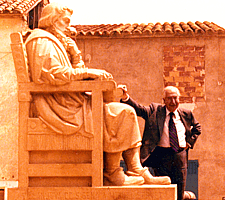
Each year, at the end of
October, the members of the Institute gather in Villanueva de Sijena
to commemorate the death of Servetus in Geneva and pay homage to his
memory before the monument that was erected by the neighbors of
Villanueva in 1975, precisely in the same place in which the Spanish
inquisition burned Servetus’ effigy.
The Michael Servetus Institute
also devotes part of its effort to study and spread the history of
the Royal Monastery of Sijena. Founded in 1188 above a lake located
half a mile from the town of Villanueva by Queen Sancha, wife of
King Alfonso II, [The Chaste - is this really part of the
king's name?], the monastery became the family tomb of the Aragon
monarchy during the XII and the XIII centuries.
During the XIV century,
the Monastery, under the patronage of Princess Blanca, the
daughter of King James II, became one of the most magnificent
monasteries of the Order of Saint John of Jerusalem in
Europe.
In order to better
understand the origins of the Kingdom of Aragon, the Institute
has constantly supported and justified to the authorities the
need to restore this landmark monument for Aragonian and
Spanich society.
The Michael Servetus
Institute is an institution open to all those interested in
the study and spread of Servetus’ legacy and the history of
the Royal Monastery of Sijena. Since the Institute was
founded, numerous famous professors, such as Alcalá Galve,
Marian Hillar, Ciriaco Morón, Fernando Solsona, Sánchez
Blanco, Bainton, Friedman, and Laín Entralgo, have been
members (consejeros) of the Institute.
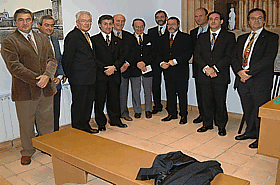
Currently, the Institute
has approximately 215 members whose task it is to continue the
work of all those , through the years, have dedicated its
efforts to claim and revisit Servetus’ life and legacy in
Spain and abroad, as well as to study and promote the Sixenian
heritage. |
|
|
|
|
|
|
|
| |
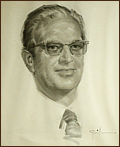 |
Mr.
JULIO ARRIBAS SALABERRI
The
Michael Servetus Institute is the project of a visionary.
Before its creation in 1976, there was not any organization in
Spain aimed at promoting and coordinating scientific research
on Servetian studies.
Mr. Julio Arribas Salaberri was
a man who used his passion for Aragón to overcome the
stereotypes associated with Aragonian culture (mostly related
to regional dancing and a traditional red or purple checked
scarf worn on the head). The most evident manifestation of
this passion was the creation of the Michael Servetus
Institute. |
|
|
Like
other great figures of the Aragonian culture, he was born in a
little town, Apiés (1911), in the Huesca Province. He studied first
in the "Escuelas Pías" of Zaragoza, and thereafter in the Commerce
School of Zaragoza where he was granted the degree of Mercantile
Professor. He also graduated from the School of High Mercantile
Studies in Barcelona.
He spent the first years of his
professional life in the Huesca Province, in which he was the
secretary general of the city councils of Bolea and de Villanueva de
Sijena, and the Finances Director in the city council of Jaca and in
the Provincial Administration of Huesca. In 1942 he was appointed
Finances Director of the Provincial Administration of Lérida, a city
located 75 km. from Villanueva de Sijena. He lived and developed his
career in this city until his retirement. While being in the local
administration, he modernized it, enhancing the services rendered to
citizens and speeding up the administrative tasks. En 1971, he was
appointed as a member of the Studies Institute of Lérida, where he
developed a meritorious research activity .
Arribas was a
man of tremendous work capacity and a controversial, passionate and
progressive personality, which resulted in some misunderstandings
and enmities. Nonetheless, the main feature of his personality was
generosity. Only by taking into account his generosity can we
understand his intense and valuable task during the years he headed
up the Institute.
Mr. Arribas served as a catalyzer and
coordinator of Servetian studies in Spain which at that time
remained very scarce, spread out and based on an anecdotic knowledge
(hence superficial) of Servetus' legacy. It must be stated without
exaggeration that Arribas is responsible, along with Professors José
Barón Fernández and Angel Alcalá Galve, for the evolution in Spain
from anecdotic Servetism to scientific Servetism. In addition, his
activities heading up the Institute marked a turning point in the
internationalization of Servetian studies in Spain As he used to
say: "I am attempting to bring together all the Servetians around
this Aragonian entity".
Equally important to his work
regarding Servetus was his personal battle to defend the heritage of
the Sixena Monastery. Mr. Arribas was, through his newly created
Institute, one of the first intellectuals to petition the
restoration of the Monastery of Sijena and to firmly denounce the
lack of will of the authorities towards Sixena's ruins.
He
died on April 22, 1984, after fighting against a long disease. He
was buried in Huerto, a little town located 30 miles from Villanueva
de Sijena.
To learn
more about Julio Arribas Salaberri, you may want to consult the book
which was edited in his honor by the Ateneo de Zaragoza and the
Michael Servetus Institute: “D. Julio Arribas (1911 -
1984)”.
Written and translated
by Sergio Baches Opi
|
| |
|
|